Restore an iPhone Backup to a Different iPhone



Backups aren’t married to the phone that made them. To restore iphone backup to different iphone hardware is exactly what Apple designed backups for. It works across models, years and storage sizes, with one version rule deciding success. Whether you’re replacing a broken phone, moving to a used one or handing history down the family, here’s the whole cross-device picture, including the cases where a full restore is the wrong tool.
Summary
Any iPhone backup restores onto a different iPhone as long as the target runs the same iOS version or newer. Update the target phone, connect it to iTunes or the Apple Devices app, choose Restore Backup and pick the right backup by name and date. The target’s current contents get replaced entirely.
| Your Situation | What Happens |
|---|---|
| Old phone’s backup onto a new phone | Works, the standard migration |
| Backup from newer iOS onto older iOS phone | Blocked until the target updates |
| You want only some of the data moved | Extract selectively instead of restoring |
| The backup is encrypted | Works, password required on restore |
Table of Contents
Can You Restore a Backup to a Different iPhone?
Yes, freely. A backup captures the phone’s contents, not its identity, so iTunes offers every backup on the computer to whatever iPhone you connect. Model differences don’t matter, an iPhone 12 backup lands on an iPhone 16 happily. Storage sizes don’t matter as long as the data fits. This cross-device freedom is the entire mechanism behind replacing a broken iPhone with a working one. It also powers every new iPhone migration done without iCloud.
What’s the One Rule That Blocks Cross-Device Restores?
iOS versions travel one direction. The receiving iPhone must run the same iOS as the backup or something newer, because a backup written by iOS 18 contains structures an iOS 17 phone can’t read. Break the rule and the restore stops with a needs-newer-software message, the exact failure Apple documents.
The fix costs nothing. On the target iPhone open Settings, then General, then Software Update and install what’s waiting. A freshly updated target accepts any backup in existence, since nothing exceeds the current iOS. Used phones bought secondhand hit this rule constantly, having sat in drawers on old software.
How Do You Restore an iPhone Backup to a Different iPhone?
- Update the target iPhone to the newest iOS it offers.
- On the target, turn off Find My iPhone under Settings, your name, then Find My, since iTunes refuses restores while it’s on.
- Connect the target phone to the computer holding the backup and open iTunes or the Apple Devices app.
- Choose Restore Backup and pick the source phone’s backup by its device name and date.
- Enter the backup password if asked, the sign of an encrypted backup, with every password predicament covered in our password guide.
- Keep the phone connected until the restore finishes, then on Wi-Fi and power while apps and media stream in.
The deeper procedure, progress quirks included, lives in our full guide to restoring an iPhone from a backup. Thin libraries in the first hours are the second act still running, not lost data, as our guide to data missing after a restore explains before you panic.
What Carries Over and What Doesn’t?
The backup delivers your messages, photos, contacts, call history, notes, app data, home screen layout and settings onto the different phone. Health records and saved passwords come along only when the backup was encrypted, one more argument for encrypting everything, per Apple’s accounting of the two backup types.
A short list stays behind by design. Face ID re-enrolls on the new hardware. Apple Pay cards re-add for security. The cellular plan or eSIM moves through your carrier, not the backup. An Apple Watch re-pairs afterward. None of it is data loss, just credentials refusing to travel between bodies.
What If You Only Want Some of the Data?
Restores are all or nothing, which turns some situations upside down. Restoring your backup onto a family member’s iPhone hands them your entire digital life while erasing theirs. Moving just the photos from a work phone’s backup onto a personal phone has no restore-shaped answer at all. Cross-device restores also demand sacrificing whatever the target phone holds.
iData Backup Viewer handles every one of those cases the surgical way. It opens the source backup on Windows 10 or 11 and shows the messages, photos, contacts and everything else inside, free. Then it exports only what you choose for adding to the other phone. The target keeps its life. The source backup stays untouched. Previewing before any full restore also confirms you picked the right backup, the check that prevents most cross-device regret.
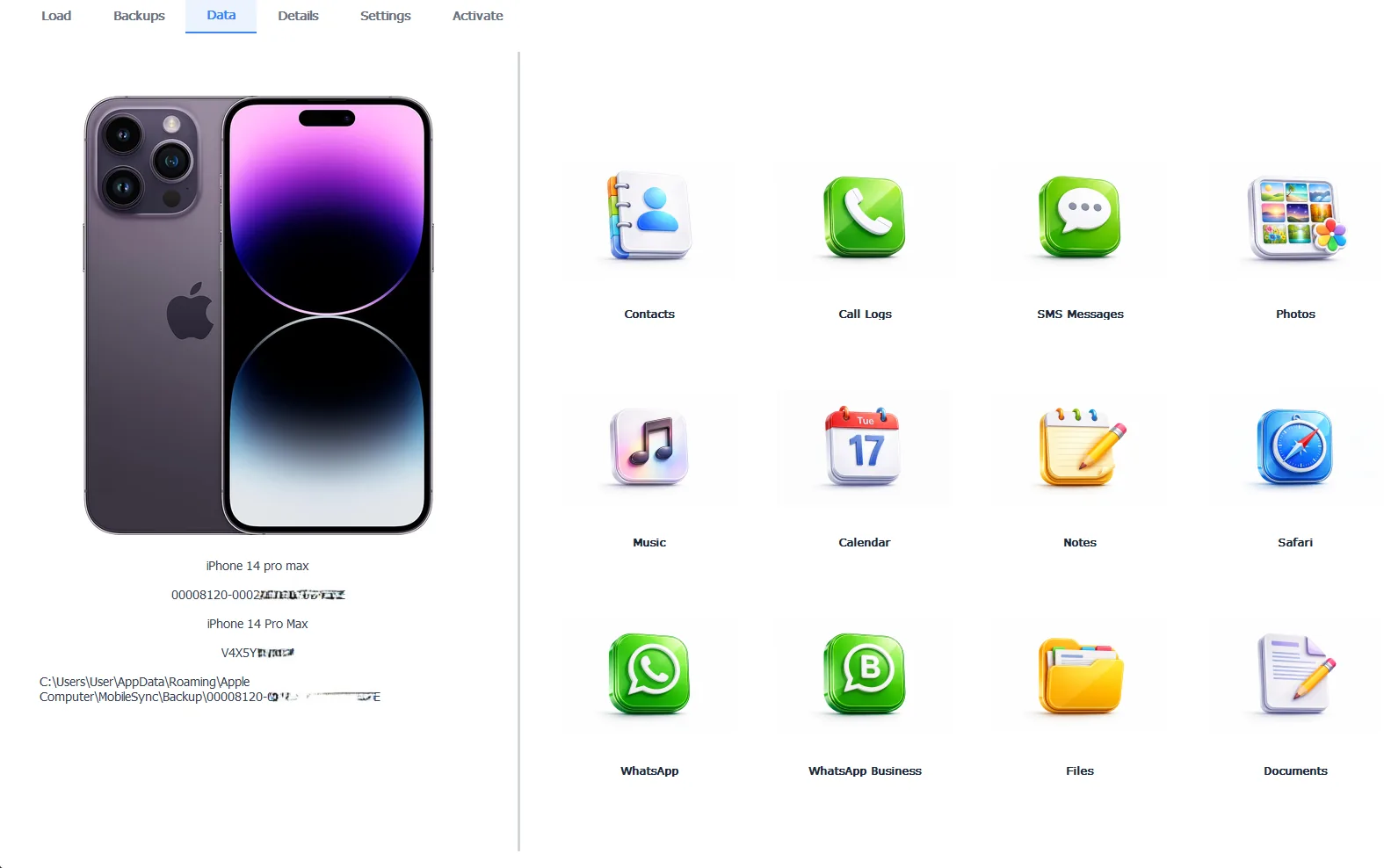
The source backup opened for selective export instead of a full restore
Browsing is free, exporting takes the Pro edition at $49 per year and everything runs 100% locally on your PC.
Free version previews your backup contents. Works on Windows 10 and 11.
“People think backups belong to phones. They belong to you. The same backup can rebuild a replacement phone today and hand one photo album to a different phone next year. The only questions Apple ever asks are the iOS version and the password. Everything else is your call.”
Viralkumar Patel in | iData Backup Viewer Team, CYBERSICS SOLUTIONS
So cross-device restores come down to a short checklist. Update the target, disable Find My, pick the backup by name and date, have the password ready and let the second act finish. When only part of the data should move, skip the restore entirely and extract. The wider map of every backup and recovery road lives in our iPhone data recovery hub.
Is the whole backup moving to that different iPhone or just the parts worth keeping?
Frequently Asked Questions
Does the different iPhone need the same iOS version?
The same or newer, never older. A backup restores onto any iPhone running at least the iOS version that made it, so updating the target phone first clears the only version obstacle that exists.
Do both iPhones need to be the same model?
No. A backup from an iPhone 12 restores onto an iPhone 16 without complaint. Apple ties backups to iOS versions, not to hardware models.
Will the restore erase what’s currently on the target iPhone?
Yes, completely. A restore replaces the target phone’s entire contents with the backup’s contents. Anything living only on that phone today needs its own backup before you begin.
Do I need the backup password on the different iPhone?
Yes. An encrypted backup asks for its password during restore regardless of which iPhone receives it. No password, no restore, with no exceptions Apple honors.
Can one backup restore onto two different iPhones?
Yes. Restoring reads the backup without consuming it, so the same backup can populate two phones one after the other, each ending up with identical data.
Can a restore merge two iPhones’ data together?
No. Restores replace, never merge. To combine data from two phones onto one, restore the larger set, then extract the missing pieces from the other phone’s backup with a viewer and add them by hand.
Written by Viralkumar Patel in
Viralkumar works on iData Backup Viewer at CYBERSICS SOLUTIONS, where he helps Windows users read, recover and export data from iPhone backups.