Selectively Restore iPhone Data from a Backup



One conversation, one contact, one album. That’s what most people want out of a backup, while Apple’s only offer is the whole phone or nothing. You can selectively restore iphone data despite that. Doing it well means knowing a truth almost nobody selling recovery software will state. Some data can genuinely go back onto the phone. The rest comes out as files you keep instead. For most of it, the files are the better ending anyway.
Summary
To selectively restore iPhone data, open the backup in a viewer on your PC and export just what you need. Photos and contacts can return to the phone afterward. Messages, WhatsApp chats, call history and notes come out as files you keep, since iOS accepts them back only through a full restore.
| The Data | The Selective Outcome |
|---|---|
| Photos and videos | Back on the phone, via upload |
| Contacts | Back on the phone, added or imported |
| Messages and WhatsApp | Files on your PC, PDF or CSV |
| Call history and notes | Files on your PC |
| Everything at once | That’s a full restore, different tool |
Table of Contents
What Does It Mean to Selectively Restore iPhone Data?
Apple treats a backup as one sealed unit, restored whole or left alone. Selective recovery breaks the seal a different way. Software on your PC reads the backup as the folder of data it really is. It shows every category inside and lets you take exactly the pieces you need while the phone stays untouched. No rollback, no trade, no time travel.
The approach works because the backup is just files sitting on your computer. Reading files is not restoring a phone. What changes per data type is only what happens after extraction, which is the split the next section makes honest.
What Goes Back on the Phone and What Becomes Files?
iOS decides this, not the recovery software, so any tool implying otherwise is selling smoke. The phone accepts photos and contacts through open doors, photo uploads and contact imports. Both can genuinely land back in their apps. Messages, WhatsApp chats, call history and notes have no such door. Nothing writes into those apps short of a full restore, whatever any product page hints.
Here’s the reframe that dissolves most of the disappointment. People asking for a conversation back rarely need it inside the Messages app. They need to read it, search it, keep it and show it. A PDF with every timestamp does all four while surviving every future phone. The file isn’t the consolation prize. For anything you’d hate to lose, the file is the stronger form.
How Do You Selectively Recover Each Data Type?
One tool covers the whole table. iData Backup Viewer opens the backup on Windows 10 or 11 and lays out every category, free to browse, with encrypted backups opening on their password and carrying the extra data Apple reserves for them.
Photos. Browse the gallery, export the shots you want and upload them back through iCloud.com, the full walkthrough split across extracting photos from a backup and restoring only photos.
Contacts. Export the card, then add the person back by hand or import at iCloud.com and let sync deliver it, per recovering deleted contacts.
Messages. Export whole conversations as PDF for reading or CSV for searching, timestamps intact, the archival craft covered in saving text messages to your computer and the recovery angles in recovering deleted texts.
WhatsApp, call history and notes. Same pattern, browse and export as files, with WhatsApp’s specifics in exporting WhatsApp chats from a backup.
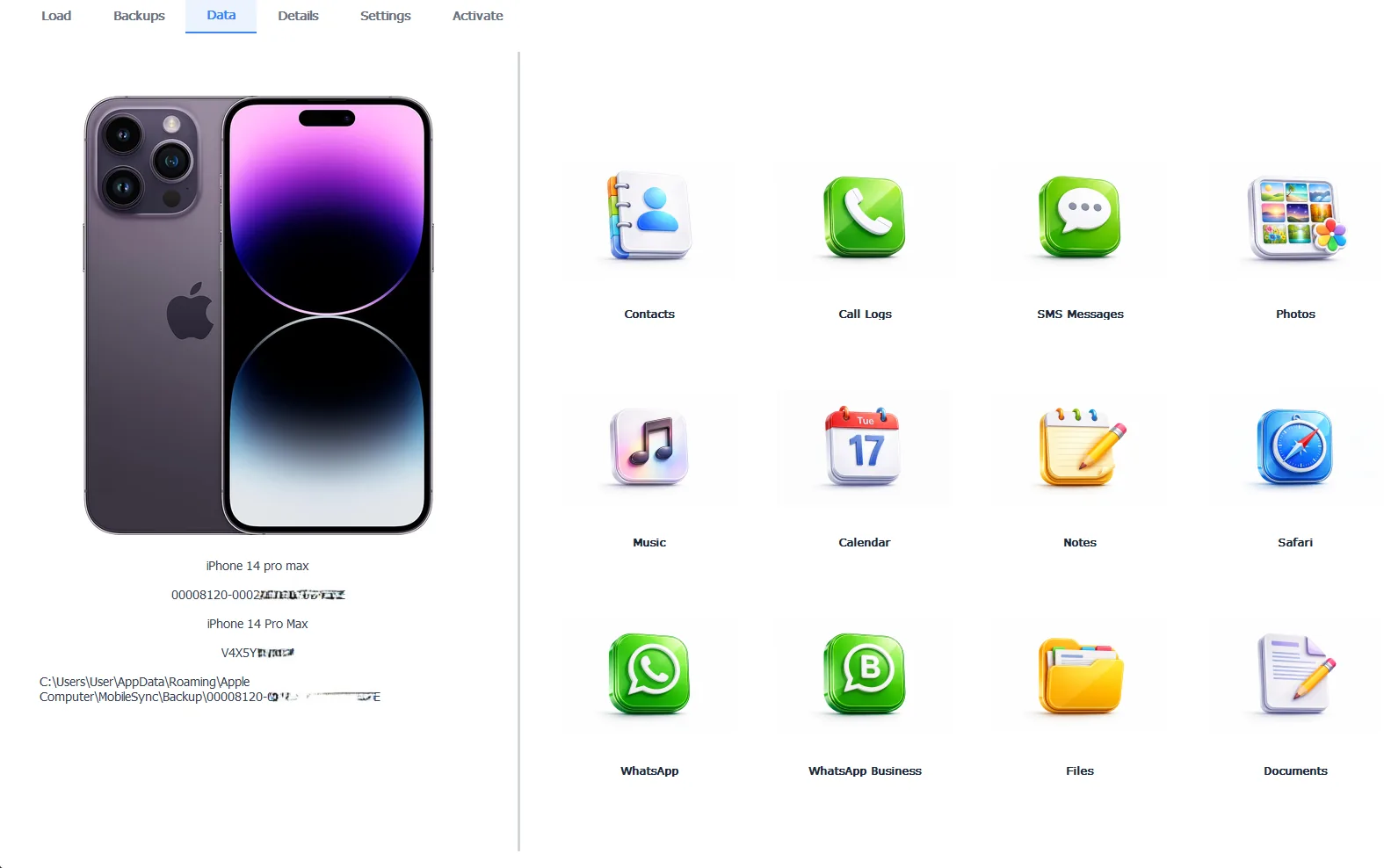
Every category open at once, taking only what’s needed
Browsing everything costs nothing, which settles what the backup actually holds before any decision. Exporting takes the Pro edition at $49 per year, 100% local. The backup itself stays read-only throughout, reusable forever.
Free version previews your backup contents. Works on Windows 10 and 11.
“The honest line in this business is admitting what iOS allows back in. Photos and contacts, yes. Messages, no. Any tool suggesting otherwise is writing a check the phone won’t cash. What we can do is hand you the conversation as a file that outlives the phone entirely, which is what most people were really asking for.”
Viralkumar Patel in | iData Backup Viewer Team, CYBERSICS SOLUTIONS
When Is a Full Restore Still the Right Call?
Selective wins when the phone’s current state matters more than the backup’s contents. Flip that and the full restore earns its place. A wiped phone, a replacement device or a disaster where you want everything back all point to the classic route, run properly through our guides to restoring an iPhone from a backup and restoring to a different iPhone. One question decides between them. How much of what’s on the phone today are you willing to lose? Nothing means extract. Everything means restore.
How Do You Avoid Needing This Twice?
Two habits close the loop. Verify each important backup opens and shows your life while it’s fresh. A backup proven readable today is a selective recovery menu forever. And treat the exports themselves as the permanent archive. Keep dated folders of conversations, contacts and albums on your PC, copied once to another drive. Files need no restoring at all, which makes them the one format that never lands you back on this page.
So take the seal off the backup and shop it like the folder it is. Photos and contacts ride home to the phone and everything else becomes files stronger than what the app held. The full restore waits in reserve for the day you want it all. The complete map of every road out of a backup lives in our iPhone data recovery hub.
Which single piece of that backup would you take if you could only carry one?
Frequently Asked Questions
Can I restore just my messages back into the Messages app?
No. iOS offers no door for writing messages into the app, so no honest tool can put one conversation back. Selective recovery of messages means exporting them as PDF or CSV files you keep. Only a full restore returns messages to the app itself.
Can contacts go back onto the phone without a full restore?
Yes, contacts are the friendly exception. Export the contact card from the backup, then add the person back by hand or import the card through the Contacts page at iCloud.com. It syncs down to the phone on its own.
Does selective extraction change or use up the backup?
No. The backup opens read-only, so browsing and exporting leave it byte for byte as it was. You can come back to the same backup for something else next year.
Can I do a full restore and then pull extras from a different backup?
Yes. It’s the closest thing to a merge that exists. Restore the backup covering most of what you want, then extract the missing pieces from the other backup as files and add back what can go back.
Does this work on encrypted backups?
Yes, with the backup’s password. Once it opens, every data type browses and exports the same as from a plain backup, including the extras only encrypted backups carry.
Is selectively recovering data free?
Browsing every category is free, which settles what the backup holds before anything else. Exporting takes the Pro edition at $49 per year, with everything running 100% locally on your PC.
Written by Viralkumar Patel in
Viralkumar works on iData Backup Viewer at CYBERSICS SOLUTIONS, where he helps Windows users read, recover and export data from iPhone backups.